


publication: Turkish and German-Turkish Pop Music
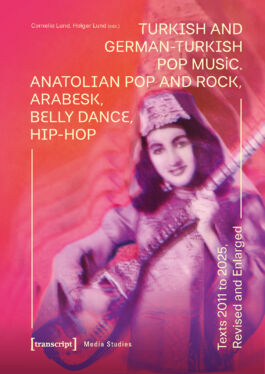
Today, the neo-Anatolian pop music scene is thriving, and there is an abundance of reissues of Anatolian pop from the 1960s and 1970s. Sparked by U.S. hip-hop beat diggers in 2006, this trend has also led to a growing musicological interest in Anatolian pop and rock. This volume compiles over 15 years of research on Turkish music focusing on productions from Turkey and Germany. Key questions include the conditions that led to the emergence of Anatolian pop as a hybrid style and its relationship with other styles, such as arabesk, belly dance, folk, and hip-hop. The status of Turkish music in Germany is also examined, asking why this vast music production was ignored and excluded from the German music market and media for decades.
Design: Chan-Young Ramert.
Open Access-pdf vailable: https://www.transcript-verlag.de/978-3-8376-7807-9/turkish-and-german-turkish-pop-music/?c=310000021
Print version: early August 2026.
Interview with transcript publisher, July 2026
Why did you choose this topic?
Turkish and German-Turkish pop music offer so many surprises, experiments and stylistic intersections. How could these stunning, versatile musics emerge? It all leads back to the (music) politics of the young Turkish nation. And how could German people not know about this music for so long? The answer lies in decades of othering and disregard of Turkish communities in Germany. Then came a sudden change, leading to widespread international appreciation of the music. What sparked that change?
What new perspectives does your book offer?
Coming from cultural, media, and decolonial studies, our research combines perspectives on Turkish pop music that have never been brought together before: seeing pop music as a multimedia conglomerate, we include perspectives from film, photography, and architecture studies, but also from political, socio-economic and migration studies. This allows us to build an entangled, comparative and poly-perspectival understanding of the music and its developments in Turkey as well as in Germany.
What makes your topic relevant for current research debates?
We offer one of the still rare comprehensive studies on Turkish pop music, including a decolonial critique of its historiography. For the first time, we also offer a comprehensive study on German-Turkish pop music. The latter shows how structural racism in Germany long blocked this music from the market and the media—which inspired Turkish people in Germany to develop an entirely new and independent music system, showing how to successfully counteract.
Choose one person you would like to discuss your book with!
We would like to discuss our book with Daniel Spicer, the author of the first English-language book on “Anadolu Psych.” Topics would be decolonial ways of understanding and evaluating non-Western pop music. What matters more? That this music sometimes sounds like Western psychedelic music (Spicer)—or that it creates something particular and unique, sometimes leaning towards the “West,” sometimes towards the “East” or—most of the time—going for a mixed, often proud “in-between” hybrid?
Your book summary in one sentence:
This book helps readers to understand how and why Turkish and German-Turkish pop music developed in such astonishing, complex, and hybrid ways.